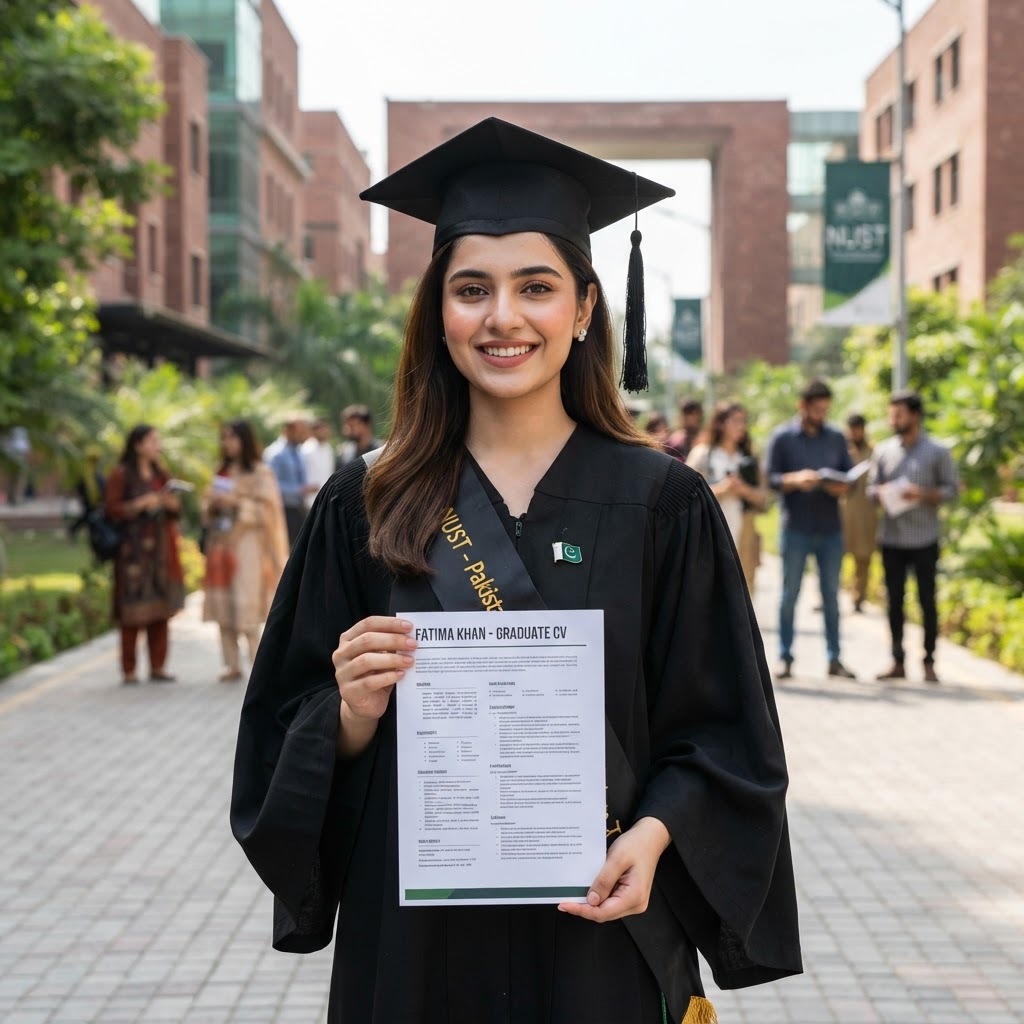
Your First Job — It's Closer Than You Think
Graduating from university is exciting — and terrifying. You have a degree, maybe some skills, but no experience. Every job posting says "experience required." How do you get experience without a job?
This guide shows you exactly how to land your first job or internship in Pakistan.
Step 1: Build Your CV
Your CV doesn't need to be fancy — it needs to be clear, honest, and relevant.
CV Structure
| Section | What to Include |
|---|---|
| Personal Info | Name, email, phone, city |
| Objective | 1–2 lines about what you're looking for |
| Education | Degree, university, graduation year, CGPA (if 3.0+) |
| Skills | Technical and soft skills relevant to your field |
| Projects | University projects, personal projects, freelance work |
| Experience | Internships, part-time jobs, volunteer work (if any) |
| Certifications | Online courses, workshops, certifications |
| Languages | Urdu, English, regional languages |
| Links | GitHub, LinkedIn, portfolio (if applicable) |
CV Tips
- Keep it to 1 page — you're a fresh graduate, not a CEO
- Use a clean, professional format — no fancy graphics
- Tailor it to each job — highlight relevant skills
- No typos — proofread twice, then ask a friend to check
- Save as PDF — never send a Word document
Step 2: Create a Masters Pakistan Profile
Masters Pakistan isn't just for experienced professionals — it's for students too.
As a Student, You Can:
- Create an InternCV — a student-focused profile
- Browse the Job Board — find internships and entry-level positions
- Apply with your CV — directly to employers
- Post on the Community Feed — showcase your skills and projects
- Get discovered — recruiters search for fresh talent
What to Include in Your Profile
- Your field (Software & IT, Engineering, Business, etc.)
- Skills (programming languages, tools, soft skills)
- Projects (university projects, personal projects, hackathons)
- Education (degree, university, expected graduation)
- Availability (immediately, after graduation, part-time)
- Work mode (onsite, remote, hybrid)
Step 3: Search for Jobs and Internships
Where to Look
| Platform | Best For |
|---|---|
| Masters Pakistan Job Board | Local jobs and internships in Pakistan |
| Professional networking and B2B jobs | |
| Rozee.pk | Pakistani job portal |
| Mustakbil.com | Pakistani job portal |
| Company websites | Direct applications |
| University career portals | Campus recruitment |
What to Search For
- Internships — "internship Lahore," "intern Karachi," "internship software"
- Entry-level jobs — "junior developer," "fresh graduate," "trainee"
- Specific roles — "WordPress developer junior," "content writer internship"
Step 4: Apply Effectively
For Each Application:
- Read the job description carefully — understand what they need
- Tailor your CV — highlight relevant skills and projects
- Write a brief message — not just "please consider me"
Application Message Template
"Assalam o Alaikum,
I'm [Your Name], a [Your Degree] graduate from [University]. I saw your job posting for [Position] and I'm very interested.
During my studies, I [mention relevant project/achievement]. I have experience with [relevant skills/tools]. I'm available [immediately / from date] and can work [onsite/remote/hybrid].
I've attached my CV. I'd love to discuss how I can contribute to your team.
Best regards, [Your Name]"
Step 5: Prepare for Interviews
Common Interview Questions for Fresh Graduates
| Question | How to Answer |
|---|---|
| "Tell me about yourself" | 30-second summary: education, skills, why you want this job |
| "Why should we hire you?" | Highlight your skills, projects, and eagerness to learn |
| "What's your weakness?" | Pick a real weakness and show how you're working on it |
| "Where do you see yourself in 5 years?" | Show ambition but be realistic |
| "What do you know about our company?" | Research the company before the interview |
| "Do you have any questions?" | Always yes — ask about the role, team, or company |
Interview Tips
- Dress professionally — even for online interviews
- Be on time — 5 minutes early for in-person, 2 minutes early for online
- Be honest — if you don't know something, say "I don't know, but I can learn"
- Show enthusiasm — employers hire attitude, not just skills
- Ask questions — it shows you're interested
Step 6: Build Your Skills While Job Hunting
Don't just wait for responses. Use your time to build skills:
Free Online Learning
| Platform | Best For |
|---|---|
| freeCodeCamp | Web development, programming |
| Coursera | Professional certificates |
| Google Digital Garage | Digital marketing |
| YouTube | Almost any skill |
| HubSpot Academy | Marketing, sales, CRM |
Build Projects
- Developers: Build a personal website, a small app, or contribute to open source
- Designers: Create sample designs, redesign existing brands
- Writers: Start a blog, write articles on Medium
- Marketers: Run a personal social media campaign
Each project makes your CV stronger and gives you something to talk about in interviews.
Step 7: Network
Online Networking
- LinkedIn — connect with professionals in your field
- Masters Pakistan Community Feed — share your projects and insights
- Facebook groups — join professional groups in your field
- Twitter — follow and engage with industry leaders
Offline Networking
- University events — career fairs, guest lectures
- Meetups — tech meetups, startup events
- Conferences — attend industry conferences
- Internships — even unpaid internships build your network
Common Mistakes to Avoid
1. Applying to Everything
Don't spray your CV to 100 companies. Apply to 10 relevant positions with tailored CVs.
2. No Online Presence
If an employer Googles you and finds nothing, that's a red flag. Have a LinkedIn profile and a Masters Pakistan profile.
3. Giving Up After Rejections
Rejection is normal. Every "no" brings you closer to a "yes." Keep applying, keep improving.
4. Not Following Up
After an interview, send a thank-you message. It shows professionalism and keeps you top of mind.
5. Waiting for the Perfect Job
Your first job won't be your dream job. Take it, learn, and build from there.
Quick Reference: First Job Checklist
- ✅ Built a clean, 1-page CV
- ✅ Created a Masters Pakistan InternCV profile
- ✅ Set up a LinkedIn profile
- ✅ Searched the Job Board daily
- ✅ Tailored each application
- ✅ Wrote personalized application messages
- ✅ Prepared for interviews
- ✅ Built skills with free online courses
- ✅ Worked on personal projects
- ✅ Networked online and offline
- ✅ Followed up after interviews
- ✅ Stayed positive through rejections
The Bottom Line
Landing your first job in Pakistan takes effort, but it's absolutely achievable. Build your CV, create your profile, apply consistently, and keep improving your skills. Your first job is the start of your career — not the destination.
Create your student profile today and start your job search.